Wellness
Nutrition: The Foundamentals & Optimizations
4 min read

Here's the thing about nutrition: it's supposed to be simple ("eat good stuff, don't eat bad stuff"). But instead, it feels like trying to assemble IKEA furniture with instructions written by philosophers. One day, carbs are the villain. The next day, fats are evil. Then a TikTok influencer tells you celery juice will cure your existential dread.
Why is it so confusing? Because nutrition science is messy. Most studies are basically:
"Hey, what did you eat last month?"
"Um...salad, I think?" (translation: donuts)
That's called self-reported data, and it's about as accurate as asking people if they floss daily. The gold standard, randomized controlled trials (RCTs), are better, but usually short. Which is like judging a Netflix series after watching the trailer.
So here's the hack: you're your own lab rat. Your genetics, gut bugs, and lifestyle are unique. That means what works for Chad on keto might make you feel like a zombie. Instead of chasing diet tribes, focus on principles that consistently work.
How You Should Eat (Backed by Science, Not Instagram)
The Big Four Foundations
Eat Real Food: Ultra-processed foods (UPFs) hijack your hunger signals. In one study, people ate ~500 extra calories a day on UPFs without realizing it [1, 6]. Your body doesn't speak "Dorito."
Watch Energy Balance: Calories matter [2, 12, 17]. But quality calories (like beans and salmon) actually keep you full, unlike chips that mysteriously disappear by the handful.
Protein = Anti-Frailty: After 40, your muscles naturally start shrinking (sarcopenia). Aim for 1.2–1.6g of protein per kg of body weight [7]. Spoiler: no, it doesn't ruin your kidneys if you're healthy [8].
Mediterranean-ish Wins: Veggies, olive oil, nuts, legumes—aka, the foods your grandmother probably ate before "diet culture" existed [9].
The Extras with good evidence:
Time-Restricted Eating: Only eat within 8–10 hours a day. It may help insulin sensitivity without nuking your muscles [10, 11].
Omega-3s: Your brain loves them. Your heart loves them [13]. But most of us don't get enough. Shoot for 1–2g of EPA+DHA daily, or test your Omega-3 Index (aim ≥8%) [14].
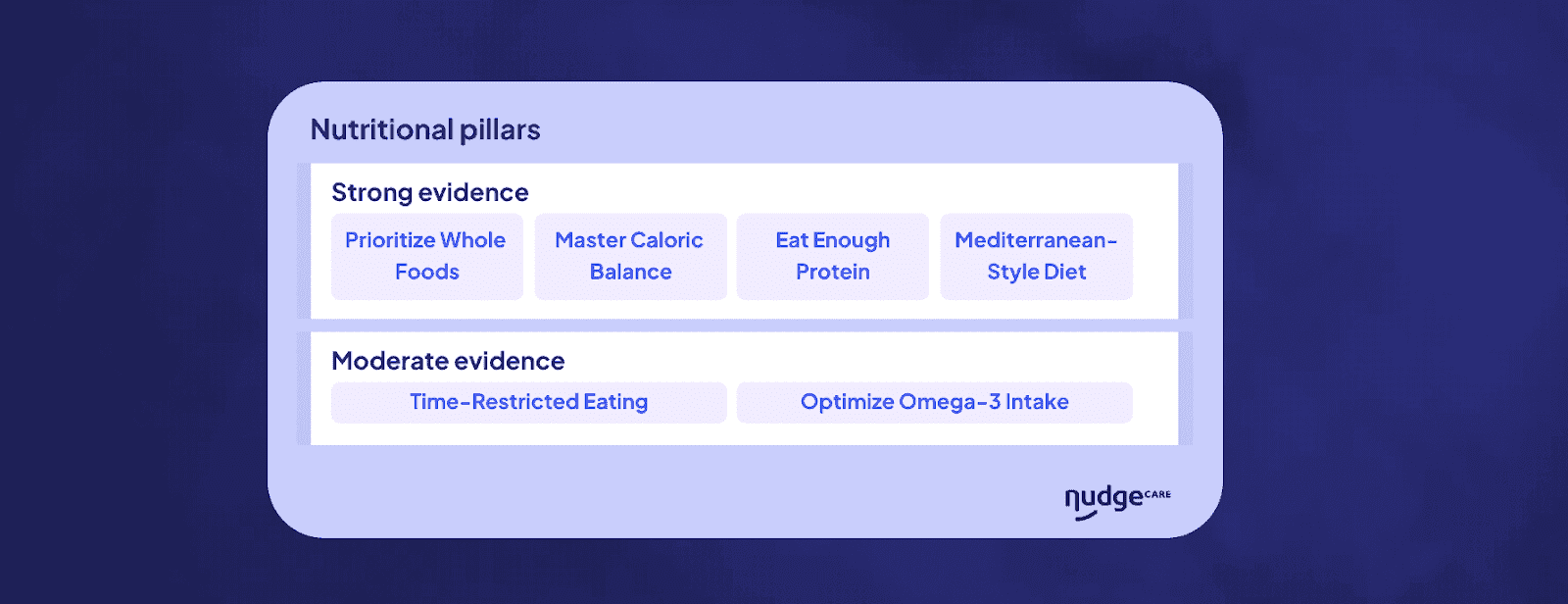
Everything else, beyond that point, is a personal experimentation you should undertake with care and help from experts, combined with frequent exams.
Myth Busting Corner
"Organic is everything." Nope. Eat more plants, period. Organic or not [15].
"Detox diets work." Your liver and kidneys: "What do you think we've been doing this whole time?" [16].
"Carbs make you fat." Only if you overeat them. Potatoes ≠ cupcakes [17].
"Natural sugar is healthy." Honey, agave, maple syrup = basically sugar in a mustache.
Learn more about Nudge Care
Build Your Health Like LEGO
Stop chasing fad diets. Build your foundation, then tweak. Your body is your lab—pay attention to the data. Think of nutrition like building a LEGO castle:
Start with Tier 1: The Foundation. Ditch UPFs, move your body, sleep, manage stress, and have friends (seriously).
Add Tier 2: Personalization. Blood work, glucose monitoring, and adjusting your protein/carbs.
Play with Tier 3: Experiments. Fasting hacks, supplements, the "biohacker edge."
And remember: you don't need to win the "perfect diet" Olympics. You just need to not lose at the basics.
Key Takeaways:
Nutrition science is complex and often confusing due to the limitations of research, such as the reliance on self-reported data and short-term studies.
A "food-first" approach is the most effective strategy, focusing on real, whole foods like a Mediterranean-style diet, which has been shown to reduce cardiovascular risk [5, 9].
Ultra-processed foods (UPFs) are a major driver of excess calorie intake and weight gain, as they can bypass the body's natural hunger signals [1, 6, 17].
Protein is crucial for aging. Maintaining adequate protein intake (1.2–1.6g per kg of body weight) can help prevent muscle loss (sarcopenia) and does not harm healthy kidneys [7, 8].
Individualized approaches are essential. What works for one person may not work for another due to unique genetics, gut microbiome, and lifestyle factors [2, 18, 19].
References
Hall, K. D., et al. (2019). Ultra-Processed Diets Cause Excess Calorie Intake and Weight Gain: An Inpatient Randomized Controlled Trial of Ad Libitum Food Intake. Cell Metabolism, 30(1), 67-77.e3.
Attia, P. (2022). Outlive: The Science and Art of Longevity. Harmony.
Ference, B. A., et al. (2017). Low-density lipoproteins cause atherosclerotic cardiovascular disease. 1. Evidence from genetic, epidemiologic, and clinical studies. European Heart Journal, 38(32), 2459–2472.
Longo, V. D., & Fontana, L. (2018). The future of human healthspan. Science, 362(6421), 1364-1366.
Schwingshackl, L., et al. (2021). Adherence to healthy dietary patterns and all cause and cause specific mortality: systematic review and dose-response meta-analysis of prospective cohort studies. BMJ, 373, n968.
Hall, K. D., et al. (2019). Ultra-Processed Diets Cause Excess Calorie Intake and Weight Gain: An Inpatient Randomized Controlled Trial of Ad Libitum Food Intake. Cell Metabolism, 30(1), 67-77.e3.
Phillips, S. M., et al. (2016). The impact of protein quality on the promotion of resistance exercise-induced changes in muscle mass. Nutrition & Metabolism, 13, 64.
Devries, M. C., et al. (2018). Changes in Kidney Function Do Not Differ between Healthy Adults Consuming Higher- Compared with Lower- or Normal-Protein Diets: A Systematic Review and Meta-Analysis. The Journal of Nutrition, 148(11), 1760-1775.
Estruch, R., et al. (2018). Primary Prevention of Cardiovascular Disease with a Mediterranean Diet Supplemented with Extra-Virgin Olive Oil or Nuts. The New England Journal of Medicine, 378(25), e34.
Kahleova, H., et al. (2020). A Plant-Based-Diet-Induced Rise in Glucagon-Like Peptide-1 in a Randomized Clinical Trial Is Associated with Lower Visceral Fat and Better Insulin Sensitivity in Overweight Adults. Nutrients, 12(4), 989.
Moro, T., et al. (2016). Effects of eight weeks of time-restricted feeding (16/8) on basal metabolism, maximal strength, body composition, inflammation, and cardiovascular risk factors in resistance-trained males. Journal of Translational Medicine, 14(1), 290.
Anton, S. D., et al. (2018). Flipping the Metabolic Switch: Understanding and Applying the Health Benefits of Fasting. Obesity (Silver Spring, Md.), 26(2), 254-268.
Gao, L., et al. (2023). The effect of omega-3 fatty acid supplementation on cardiovascular disease: an updated meta-analysis of 22 randomized controlled trials. Frontiers in Nutrition, 10, 1269871.
Harris, W. S. (2010). The omega-3 index: from biomarker to risk marker to risk factor. The American Journal of Clinical Nutrition, 92(4), 843-844.
Baranski, M., et al. (2014). Higher antioxidant and lower cadmium concentrations and lower incidence of pesticide residues in organically grown crops: a systematic literature review and meta-analyses. British Journal of Nutrition, 112(5), 794-811.
Klein, A. V., & Kiat, H. (2015). Detox diets for toxin elimination and weight management: a critical review of the evidence. Journal of Human Nutrition and Dietetics, 28(6), 675-686.
Srour, B., et al. (2019). Ultra-processed food intake and risk of cardiovascular disease: prospective cohort study (NutriNet-Santé). BMJ, 365, l1451.
Ference, B. A., et al. (2017). Low-density lipoproteins cause atherosclerotic cardiovascular disease. 1. Evidence from genetic, epidemiologic, and clinical studies. European Heart Journal, 38(32), 2459-2472.
Fontana, L., et al. (2018). The future of human healthspan. Science, 362(6421), 1364-1366.